For the past 24 hours I’ve been preoccupied with learning more about my personality type (INFJ). Unfortunately, this has caused me to procrastinate on homework and reports that need to be done by Monday morning. I must admit, after reading about all the characteristics of INFJ’s I realized that I wasn’t as crazy as I originally thought (wonderful surprise). The truth is that INFJ’s make up less than two percent of the world’s population and is the rarest type in the Myers-Briggs test. This prezi presentation was so amazingly good and was a wonderful overview of the INFJ personality. As I clicked through it I could relate to every part of the presentation. Then I ran across this article that was also incredibly interesting as it summarized some of the characteristics of INFJ’s. Several things that stand out to me (and that I’ve noticed in myself) about this particular personality type is that we can’t get out of our own heads. Our brains are always going several hundred miles per hour and we are future oriented. This means that being in the present and enjoying the moment takes very deliberate effort. Also, we are perfectionists and hold ourselves to a very high standards. In addition, we trust our gut and can read people well. This characteristic is something that I realized that I use a lot more often than I originally thought because it’s more like second nature to me. The thing is that this intuition or gut feeling doesn’t always make sense. I don’t know how many times I didn’t do something because it just didn’t “feel” right. I couldn’t explain exactly why I felt that way but I just did. INFJ’s are social but still like time by themselves to recharge and they are easily annoyed by small talk, meaningless conversation and also meaningless affection (go figure). They like structure but they hate monotony and appreciate spontaneity. I guess that’s why I’m such a fan of traveling and taking a break from routine. Who would’ve guessed?
Category Archives: What I Think
Dexter
As I’ve mentioned before in some previous posts, I don’t watch a huge amount of television. As a result, I’ve grown to have an appreciation for the commercial free atmosphere of Netflix. In addition, it’s nice to watch seasons of shows instead of waiting for a week before the next episode. One show that has really grabbed my interest is Dexter. I just finished season 4. I only watch the show in short bursts because it can be fairly intense, but I’m drawn to the complexity of Dexter’s childhood and how it has affected his behaviors as an adult. By no means do I think that the show is child friendly but it is SO intriguing from a human behavior/psychology perspective. The show is about a blood splatter analyst (Dexter) who has a secret of his own. He wrestles with being a traditional family man and keeping his big secret from others. Dexter has had a traumatic experience in his early childhood that has set him apart from other people. He had a father who taught him how to function in a way that would prevent him from spending the rest of his life in prison. The unique thing about the show is that the storyline is in first person. Dexter struggles in every episode with what he is expected to be and who he really perceives himself to be. While Dexter’s challenges with his secret are more marked than many other people, in every season he becomes more of a person. Watching Dexter navigate his personal and work relationships is a reminder to me of how often we can stereotype or assume things about others. On the surface, no one would ever guess that Dexter has this huge secret because he struggles with being genuine and honest with himself and others. As a result, Dexter has few close relationships.

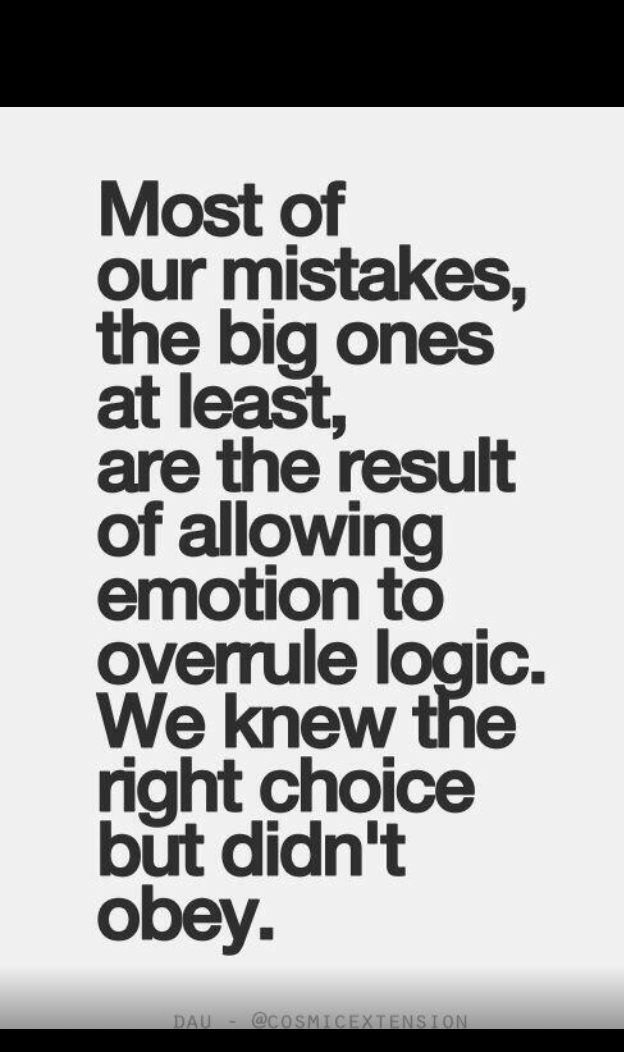
Overruling emotion
I’ve heard a saying that said you should never make a major decision when you’re very sad or very happy. While this sometimes can’t be avoided, I can’t help but think that there is some truth to the words of this picture. How many times have rash decisions been made in the heat of a moment that changed someone’s life. In lieu of the events and protests that have happened in the last few months, maybe it would be a good start to plan before pursuing and to work toward systemic change by engaging and creating dialogue between affected parties.
Ignoring the Obvious
A few weeks ago. the brake light came on in my car. It happened while I was driving but quickly turned off when I took my foot off the gas. I ignored it. As the weeks passed my brake light came on more and more often. I knew the brake wasn’t on and there wasn’t any weird noise happening so I continued to ignore it. In fact, I started to appreciate the extra light on my dashboard that came from the light being on. This continued to the point where the brake light was almost on all the time. It became almost constantly on from the time that I started the car until the time that I turned it off. Almost comforting in a way. I could have called my dad and asked about it (my usual plan of action on anything concerning my car) but I didn’t. I could have googled information about it and problem solved on my own but I didn’t do that either. Instead I just ignored it until it became comfortable. This past weekend my dad visited me in person and I finally told him about the brake light. Turns out it was a three minute solution. My car just needed more brake fluid. So now I drive around and my dashboard is strangely (or so it seems) dimmer because the bright red light isn’t on anymore. It makes me thing about all the times that we ignore things that are problems until we just become comfortable with it. People who are in abusive relationships to the point that it just becomes normal because they can’t clearly remember anything different. People who get caught up in negative cycles because they ignore red flags until the red flags are no longer important to them. Sometimes you have to learn to be uncomfortable with dysfunction because you’re so used to it that it has become normal. It’s a similar concept with people who are recovering from addictions of some sort. They have to re-learn how to live without the addictive behavior or substance because it has become such a way of life. However, the beginning step of this process is challenging the dysfunctional or “normal” reality that they have created and taking the necessary steps to create a new normal.
Ferguson Part II
Once again, the Mike Brown case has regained momentum in social media, the legal world, and also in the actions of thousands who are protesting the most recent decision made in the case. There’s conflicting reports on what exactly happened but the truth of the matter is that Mike Brown should not be dead. From as young as I can remember, I was taught to respect authority figures. This included policeman. However, this teaching was also followed by positive contacts and interactions with policeman. We personally met and sang to our city’s chief of police. Our landlord was a former chief of police for the city and was a great person who went against the unspoken segregation rules of the city and rented a house to a black family on the white side of the train tracks. His sons were also active police officers who my siblings and I had the chance to interact with and ask questions about their jobs. As someone who fairly frequently has to call the police on someone or for someone, I can say that there are police personnel who do well at their jobs and those who do not. I absolutely believe that race does play an issue in the Mike Brown situation and other similar shootings that have happened in the last decade where innocent black men have been killed. With all the protests happening across the country and possible solutions to racial equality being submitted by many, I think that the value of respect played a role in this very unfortunate and tragic situation. Disrespect on both sides. I wonder if Mike Brown personally knew a lot of officers. If he had any prior positive interactions with law enforcement in a neutral environment. Lastly, I wonder if these positive interactions would have changed the outcome of the day. The truth of the matter is that if you’re being robbed, car-jacked, assaulted, or stalked, most likely you want the added presence of someone in law enforcement. Maybe part of the bigger solution to this whole mess and cycle of unnecessary deadly force is to push for accountability while also advocating for stronger community relationships between citizens and the local police force. No, it’s not going to be a cure all for all racial tensions but it just might ease it a bit.
Sleeping In

I’m a self-described night person who has been forced to be more of a morning person due to work obligations. As a result, I’ve become more appreciative of the days where mandatory attendance in the morning is not necessary. I can understand the importance of accomplishing work early in the day, but I would also like to be fully awake. Getting up in the early morning is an example of discipline that I have had to develop despite my natural balking at someone deciding my schedule for me. Regardless, I think that this might be some form of preparation for motherhood. Taking actions despite emotions that might argue otherwise. I think that can be a good thing.
Husbands and Fathers
This is an article I came across recently that was fairly thought provoking to me. As a therapist, I’ve learned how to roll with the choices people make even if I may not personally choose to make those exact choices myself. No judgement. However, one thing I have not personally grown mature enough to understand (and maybe I’ll never be) the decisions that some people make when choosing the person they make a baby with and not make a judgment on their mental capacity. That being said, working at a job where I interact with children who have been abused has convinced me without a doubt that there are some people who should never ever ever be parents. I am of the opinion that some men make great fathers and other men make great husbands and that sometimes these two things do not go together. Don’t get me wrong, I think that there are some characteristics that both fathers and husbands should have that overlap with each other. But I think that the roles of a husband and that of an engaged, aware, and mature parent are different. The article is a little on the humorous side but it does make you think about the difference between a spouse and a parent. While selfishness in a marriage can cause problems, a selfish parent can negatively impact the life of the next generation. Communication between adults is different than communication with children. It’s not healthy to be enmeshed with a child in the same manner you are with a spouse. Totally different ballgame. Raising a child successfully without messing them up for life requires a different set of skills than having a relationship with another mature adult. It’s nice to have a great husband and it’s wonderful if a man is a good father, but it’s even better when a guy can be both at the same time.
Thank you
One thing that was drilled into my head from childhood was the importance of saying thank you. It’s a habit that has followed me through adulthood. A thank you is an acknowledgment of something or someone that made an effort in some way to positively impact you. Recently, I rented a 2014 Toyota Camry and really enjoyed it. I drove the car over 1000 miles in a period of four days and it was one of the best driving experiences I’ve had in my life. It was very apparent that the car was designed with a driver in mind and all the amenities and bells and whistles were easily accessible while driving. The sound system was excellent and the car practically drove itself–giving me the opportunity to contemplate my life in great detail. Needless to say, it was a great experience and I took the time to write a handwritten note (the best kind) to Toyota corporation thanking them for the work that they did in making the Camry a great car. I sent this letter to their headquarters in Japan. Lo and behold, a few weeks later I received a personal letter from one of the Toyota vice-presidents thanking me for my letter and saying that it was being circulated through the Toyota divisions for the employees to read. I’m always amazed at how rare it is to receive a handwritten thank you note for ANYTHING these days. As digitized as we make our lives, there’s nothing like knowing that someone appreciated what you did for them and took the time to write you personally and express their gratitude. Any and every act of kindness toward you should be responded to with a “thank you.” It’s basic good manners and common sense. And that doesn’t go out of style. Ever.
Regrouping

We’ve all heard the cliche sayings and adages about the the consequences of quitting. It’s pounded into our heads that giving up should never be an option. We advise people fighting life threatening illnesses to fight and seek aggressive treatment. We soothe ourselves with the thought that not giving up has rewards in and of itself. But at what point in the game does giving up become a question of survival? When do we have to just call it and tap out? At what point is fighting futile and pointless? I think that there are times in our lives when we have to recognize that going any further in our fight is a undeniable sign of insanity. That doesn’t mean that the fight is not important but it does mean that there are more important things–like regrouping and doing something else.
ABD life
Earlier this year I posted about the dilemma of finding a topic for my dissertation. I can honestly say that at the beginning of this thing I had no idea the time and energy that it would entail. Any advanced degree in the social sciences typically involves a lot of writing and this particular one has been no different. Two LOOOOOONG years of classwork have recently ended with the last class being a doctoral level statistics class that I thought I was going to epically fail. However, I passed by the literal skin of my own teeth with a “B.” While I like distance learning, I also like the interactions that come along with being physically present in a traditional classroom. While I’ve been consistent with keeping up with the expectations of my program and turning in my assignments on time, I haven’t taken it seriously. It’s been a time consuming hobby. Not because I don’t take my life and professional goals seriously, but because I picked a fairly broad concentration that combines work I’ve completed in other disciplines. The next hurdle is that of starting, working on, and completing my dissertation. Thankfully I’ve finally arrived at a topic and after 3 months of emails and subsequent rejections have finally finalized a dissertation committee. So now I can categorize myself as ABD (all but dissertation) in the scholarly world. I can add “PhD. Candidate” to my email signature and even apply for jobs in higher ed. An added bonus was the fact that I could take a three month break and still be on track to graduate on time. All that being said, one of the interesting facts I learned this summer was that only 1.9% of people who start a doctorate complete it. That means that 98.1% of people who start one do not finish. That fact is motivation for me to finish what I started and to add another set of initials behind my name. The school thing isn’t finished and won’t be for a bit but with some dedication and consistency combined by my decision to take school seriously at this point in the game I’ll conquer this last mountain.
 Alisha's Angle