I consider myself an undercover touchy feely person. I say undercover because in no way, shape, or form does it appear that way to many people that know me. I’m the person who would much rather sit by myself than be commanded to “turn to my neighbor” or “give my neighbor a hug.” Quite frankly, I find it awkward and extremely annoying. This often happens in church-like settings where apparently the leader of some sort is trying to break the ice and apparently build lifelong bonds between people in the audience. Call me mean, but that’s not my intention. I don’t mind meeting new people and I have a nosy personality that seeks to find out what makes someone tick. I like to hear life stories and get advice and direction from people with a different perspective. However, I’m not down (and may not ever be) with hugging perfect strangers and telling them that I love them because I was told to do so. I remember reading somewhere that giving or receiving hugs can help the body and improve mental health. While I’m not agreeing or disagreeing with this, in my case hugs with perfect strangers do not count towards my “daily hug quota.” I don’t usually even know the person’s name. But refusing a hug creates one of the most awkward moments–especially if you don’t know the person. I honestly think that a hug in this type of situation is a type of meaningless affection. It means nothing. Conveys nothing. Accomplishes nothing. Now I know that other people would disagree with me and I’m sure that there are plenty of people who hug perfect strangers because there is a legitimate purpose. But in this situation, hugging someone because you were told to do so does not count as a legitimate reason with an actual purpose. Humans can be so trained to do whatever someone tells them to do because they have some sort of title. Makes no sense to me. Will I ever sit next to someone and inform them that I don’t do hugs from strangers? Probably not. But will I continue to cringe in my head whenever I hear a “turn to your neighbor?” Yup. What can I say? I just feel more comfortable hugging people I actually know.
Author Archives
The real you

These words are so true in my opinion. As soon as I saw the picture I knew that I had to write on it. First off, I’m not a very patient person. I don’t usually have a problem waiting, but I do have a problem patiently waiting. One of the hardest situations for me is being in a situation where I can’t occupy myself with something else while I’m waiting. I recently got called for jury duty and I had an extremely hard time sitting in a room with nothing to do for a few hours with a several hundred people waiting for my number to be called. But I digress. The point of the picture as it pertains to patience is that patience is extremely hard to come by when you are waiting for everything. There are numerous rags to riches stories of people who went to poverty and still were patient and believed that their circumstances would not be forever. The second part of the picture talks about attitude. I think that we’ve all known someone or even been in a position ourselves where we’ve gotten a raise, promotion or some sort of upgrade in life and our attitude changes. Your thinking won’t change just because the amount of material possessions that you own did. I think that having “everything” is a magnifying glass on your true attitude. It’s interesting how our circumstances can be so revealing of who we really are as people. They can shape our perspective and make us more trusting or more suspicious of others. They can not only change us, but also show others our true colors and motives.
Who’s your hero?
I think that everyone at some point in their childhood desired or wanted to be like someone else. Whether it was a character from a TV show, or even a person that had admirable qualities. I think that you can tell a lot about a person by who they name as their hero. I think that we pick heroes based on our own perception of our deficiencies. We pick role models based on the fact that we see something in them that we want to emulate in our own lives. I don’t remember having a lot of heroes growing up. While I admire and respected certain people for their accomplishments, I can’t honesty say that I remember declaring that so and so was my hero (or shero). I know people who have the opportunity to be mentored by other people who they consider their heroes. While I love the idea of having a mentor, role model, and hero all rolled into one person, I wonder how realistic it is to expect to encounter that. In my work with kids in the therapy room, I’ve noticed that the term “hero” can have many different meanings. I think that our heroes change as we grow older and develop our own unique perspectives. Take a minute this week to think about who your hero is and what qualities that they had (or have) that you are still working towards then jot down some ideas of what you can do or focus on to practice some of these qualities.
Situationships
I’ve encountered a lot of people recently who have gotten into situationships instead of relationships. A situationship occurs when you get into a psudo-relationship with someone else because you’re going through a hard time in your life or you’re facing a lot of situational stress. The bottom line is that you aren’t thinking clearly. Many people in these situations are emotionally vulnerable and they easily settle for someone who appears good for them because they are tired of being alone. However, when they discover that they’ve made the wrong choice, they still don’t do anything differently. I personally think that some of the most dysfunctional relationships are born out of desperation. People want the ideal relationship but never actually take the time to think through their actions. We are friends with people we don’t like. We marry people we don’t like. We even have children with people we don’t like. This does nothing but add to the confusion and chaos in our lives. We (including myself) have to come to a point where we stop doing permanent things with temporary people and expecting everything to work out. It’s important to realize that it is so much easier to slip into a situationship than it is to take the time to grow and build a genuine relationship. Remember that situationships are just that. Situational. They have a very low likelihood of ever succeeding because you’ll realize that you don’t need or even want a situationship any more after the situation has passed. They’re a temporary fix to a long term problem. Stop settling for people you never even wanted in the first place. You’ll never get back the time you wasted.
Letting People In
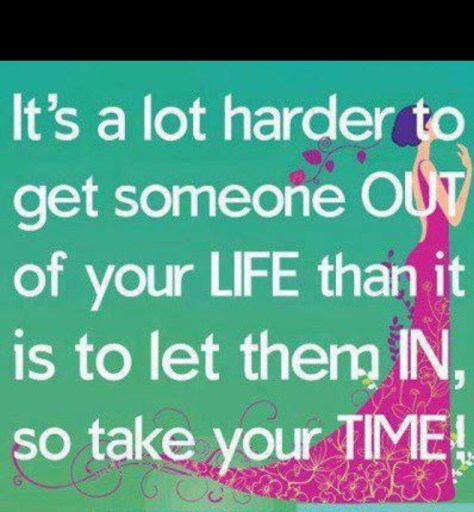
I totally agree with this picture. While I don’t think that you have to be standoffish and mean, I think that less is more when it comes to letting people get super close to you. I know that everyone is human and we all make mistakes and that we can’t expect perfection from our friends but it’s still ok to be cautious before spilling your guts to someone you call a friend but have only known a short time. Someone once said that you should never trust anyone who only has new friends because that’s an indication of the quality of their prior relationships and friendships. Sometimes doing more groundwork on the front end of a friendship or a relationship can save you a lot of heartache and hurt down the road. One thing that I’ve noticed is that I’m somewhat of an extremist when it comes to putting the words in this picture into practice. For instance, every person in my life that I consider close and feel that they know me well I’ve known for three years or more. This was not a conscious decision, it was just something that happened and can probably be blamed in some way on my upbringing. But I digress. My point is that it’s good to screen people and to let them prove that they can be trusted before you open the floodgates of your heart and let them 100% into your life.
One thing that never fails to annoy me is when people state emphatically that people in relationships or married people have no business going to or seeking counsel from people who aren’t married. Now on the surface this perspective appears to make a lot of sense. What business do you have going to someone who isn’t in a relationship themselves to get advice? What if you followed this advice and went to someone who was actually married and their advice wasn’t sound because they could only give counsel in the context of their current situation and could only say what they would do if they were you? One of the reasons that I think that this logic is flawed is that when you apply it to other situations it makes absolutely no sense. Do you refuse to be treated by a medical professional because he or she has never experienced your particular medical challenge? Would you refuse the aid of a lifeguard when you’re drowning because he or she has never been in your predicament before? Or better yet, would you ignore a policeman or a fireman when you’re in a dangerous situation because they haven’t been in your shoes? Absolutely not. The reason why we are willing to trust these people and take their suggestions, directions, and counsel so seriously is because we believe that they have skills we don’t possess and we trust in the quality of their training. The same concept applies to therapists. If someone took the time to get the necessary education and gain the right skills, their current relationship status is irrelevant. A lot of people don’t realize the work that goes into becoming licensed to provide therapy. In addition to a master’s degree, you have to work in the field for 2 years or more after graduation and complete at least 3000 or more work hours depending on your state. I say all this to say that you should trust the training a therapist has instead of writing him or her off because they aren’t just like you. That’s stupid.
Trusting someone’s training
Public Tears
I’ve always respected people who could openly show emotions like sadness or happiness in a demonstrative or vocal way in public settings. That’s never been me. There was a time where I would start to become uncomfortable or feel awkward when someone around me would start to cry loudly. However, I have become much more comfortable with emotion as I have done more crisis work. There’s no more awkwardness because I know where the tissues are located and I’m comfortable with giving people some time to cry it out. But when it comes to me, I’m totally different. I’m not the kind of person that will burst into tears in a large group of people. HOWEVER, as much as I can’t cry for myself in those type of situations, I can just as easily cry at the drop of the hat for someone around me that I know is experiencing. It’s something that I’ve been able to do since I was little. I can easily “tune in” to the emotions of other people and that’s probably one of the reasons why I decided to be a therapist. Sometimes it’s helpful to talk to someone who can both empathize but can also challenge you to see things from a different perspective. And honestly, sometimes when someone is going through a really rough or stressful time, they don’t want mountains of advice. They want to feel heard and for someone to cry with them.
My Story of Overestimation
Growing up, I always felt that people were overestimating me. I honestly think that as long as homeschooling has been popular, there has been the opinion or perspective that homeschoolers are smarter than their traditionally educated counterparts. Now, whether or not this is true, I don’t know. And I don’t care. When I was little, people would immediately gush over me and my siblings and talk about how smart we must be because we were homeschooled. I grew up knowing that people expected me to succeed in life and become something because I was homeschooled. I didn’t particularly care for it because I found it annoying. Was I smart because I was homeschooled or was I homeschooled because I was smart? For the most part, I did get a chance to live up to the “smart” expectations–at least by society’s measurements. I was a senior in high school at age 15 and had the luxury of finishing high school a month after my 17th birthday and taking a year off to chill out before I went to college. In more recent years, I’ve gotten the chance to separate myself from the “kid genius” expectations and quietly do what I need to do. In fact, the tables have turned to the point where I’m often underestimated. It’s mildly annoying to have people around me assume that I’m still in college or that I don’t have anything going for me. Yet, I’d rather be underestimated than over estimated. Being underestimated can put you in a spot where you are your biggest competition. You have less time to invest in pleasing others or meeting their standards because they don’t expect you to do anything worthwhile. I’m not talking about constantly downplaying your accomplishments, but also not going out your way to be flashy and dramatic about all your future plans. If I ever become “big” or super successful I want it to be unexpected. Being successful doesn’t have to be advertised, it can be discreet. Underestimation isn’t a bad thing–it can even work for you.
Complementarity

This picture really made me think. So many times I’ve heard people say that we get what we deserve. They use this perspective to justify the reason why people can be in numerous toxic relationships. Along with this mindset comes the assumption that if you work on yourself and become better, than you’ll immediately attract a better caliber of people. But the honest truth is I think a lot of people want to feel that their significant other is an upgrade from themselves. I don’t know if people can be literally perfect for each other but I think that they can strongly complement each other. Think about it. Wouldn’t you work harder and do more to keep something you felt you didn’t deserve as opposed to something on your level?
The truth about transitions
One thing that has really popped up for me in the past few days is the importance of transitions in our lives. Life is full of changes and it often seems as if there isn’t any stability. Transitions occur at so many stages of our lives. They are both planned and unplanned. While we can’t always plan for the transitions, the bigger question is how we respond to them and who do we surround ourselves with while we’re going through. It’s important to know that every transition in our lives comes with the opportunity to learn and grow–regardless of the fact that the circumstances may be less than ideal. There is no such thing as a transition free life because there’s no such thing as problem free life. Transitions happen. And often opportunities for growth are often disguised in the unpleasant or uncomfortable.
 Alisha's Angle