Recently, I’ve come across a relationship situation that doesn’t quit fit the “just friends” category that we like to put platonic male and female relationships into. It’s not the friend zone where there’s a decided lack of interest on one side. It’s more complicated that that. I like to call it being in the homie-hood. In this case, you are not thousands of miles away from a romantic relationship, you’re actually in the neighborhood. However there’s is a deliberate sense of ambivalence being in a homie-hood. There has never been an understanding as to where the relationship stands so both people have the liberty of drawing their own conclusions around the interactions that happen between the two of them. They don’t take the time to have a conversation about the status of the relationship. There’s an unspoken rule that at the very least, both people are cool with each other. At this point neither will admit that they are playing the song and dance of a relationship without any of the commitment or labels that might come from a more deliberate decision to pursue a romantic relationship. There are no rules and all the lines are blurred. While this leaves a lot of room for misunderstandings, both people decide that it’s not worth rocking the boat over it. While you know when you’ve been friendzoned, the homie-hood sort of just happens. There’s no warning and no definite communication. It’s a sea of grey; which means that all things are open for personal interpretation because neither party will clarify. It may seem better than the friendzone but in reality it’s a place uncertainty because there’s a lack of communication and an understanding that there is an “understanding.” This is in spite of the fact that neither party has actually defined anything or discussed expectations. It’s a friendship that has the potential for something more but floats along in the sea of possibilities without dropping an anchor.
Category Archives: What I Think
Running Away
Running away from something is an action that I’m convinced every single person has done during their lifetime. We procrastinate, ignore, deny, disassociate, and just plain out avoid things we don’t feel adequate enough to face head on. Yet, all these methods don’t solve the problems. One of the things I’ve learned is that fear of something in the present or the future can cause us to run away. The term doesn’t always indicate distance in a geographical way, but rather a deliberate effort to avoid that which would be uncomfortable. Running away can be a solution but sometimes people spend their entire lives on the run until they forget what they’ve been running from. This in itself can be problematic because you can’t grow from what you refuse to confront. Additionally, a life of avoidance will catch up with you in one way or another.
Real Struggle
This week has been one of stress, deadlines, and people in crisis. It started with a very stressful meeting on Monday morning and spiraled from there. As I get up to go to work each day, I think about the thousands and probably millions of people who are institutionalized in some form. The people who we never think about because we are too busy living our lives. Those who spend days, months or years in one room because of physical or mental limitations. Or even the little kids who spend a significant part of the day inside a building sitting when they would rather be playing outside. The world isn’t fair and it will never be. The sad thing is that sometimes we institutionalize or confine ourselves without even knowing it. We feel bad about those around us and feel powerless to help them while we continue to limit ourselves on a daily and maybe even hourly basis. One of my goals in this new year is to identify and disrupt negative cycles that impact me personally. In addition to helping others, I want to help myself. To not become so immersed in the struggles of others that I leave my own life unattended. We’ll see how that goes.
No Contact Part II
This post is somewhat of a continuation to a previous one. I discussed a no contact order and when it is usually appropriate as a choice. Lately I’ve had to put myself on one and it has not been fun. However, the purpose of a no contact order is not for convenience. It’s a choice that’s made in order to get some clarity or even some space from another person. We all hate getting mixed messages and sometimes interacting with people on a daily basis can increase the likelihood of misunderstanding. I’m not advocating for avoidance and the great thing about a no contact order that I’m learning is that while I make my own terms I also have to stick to them. I’ve noticed that my no contact order has increased my awareness of what’s going on around me. This has been a good thing but it has also been challenging because I’ve noticed that there’s a lot of things I intentionally ignore and now I’m picking up on things I would normally not notice or ignore. It’s somewhat similar to being hyper vigilant. In my situation, the no contact order wasn’t something that I would normally choose for myself but the situation absolutely demands a more radical reaction and plan. That means that emotions and feelings have be pushed aside for the purpose of achieving some clarity and enough space to make a decision that is not purely emotional. Instead of operating on a hunch or a feeling, facts and logic also have to be considered and my no contact order is making that possible. Despite the fact that it’s not fun and doesn’t have an end date, it’s helping me to separate emotions from facts and make better informed decisions. Not an easy process but maybe (hopefully) worth it.
The problem with thinking positive all the time
I must admit that this article made me especially happy. It confirmed my personal beliefs about the effectiveness of positive thinking. Plus, it’s written by a psychology professor. Anyway, the basic premise the article is that positive thinking may not be as good as people once thought. Positive thinking needs to be informed with something that we affectionately call reality. It’s great to look at the silver lining but you need to also consider hard truths. People who imagined their goals while thinking about both achieving them and also the challenges that they would face had a better change of realizing their goals.
Black and White
One of the benefits and perhaps one of the setbacks of being in school for years and studying human behaviors and personalities is that you see the world being less black and white than you have originally thought. Classes that shock you and challenge you to critically think can also make you able to think in the gray. This is one thing that I’ve learned to function in for the purpose of doing my job. I deal with things that are not absolutes on a daily basis because people are involved. They aren’t numbers that can easily be manipulated to get the same exact result every time. The process is often messy and involves variables that were not considered at the beginning. I’ve learned to take outside factors into consideration when making a clinical judgment on someone’s behaviors or actions and to hear both sides of the story before aligning too closely with one client. It’s not an easy task to do and sometimes involves feeling uncomfortable. However, despite my ability to function in the grey and not make rash decisions or judgment calls on behaviors without knowing as much as possible, I still like the black and white. Decisions are so much easier to make when they are clear cut. Professionally I’ve learned to work in the gray but personally, I like the black and white because it simplifies life. The “all or nothing” mentality helps me to stay focused and decreases distractions. However this makes it easy to swing to extremes without even attempting to find any middle ground. You make decisions and stick to them without being worried about repercussions. It’s easier to be assertive and attentive to what’s going on around you. But I think that it’s easier to miss nuances and smaller things because the focus is on the black and white instead of making allowances for the grey things in life. The truth of the matter is that life is about adjustment and change because our lives will almost never go exactly according to plan 100% of the time.
Pregnancy Contracts
I must admit, as a childless adult, the idea of pregnancy contracts was completely foreign to me before I stumbled upon this article. The idea of a pregnancy contract is that it specifies the responsibilities of each parent at the arrival of a baby. While I personally think that it’s a good idea to have a discussion about responsibilities and that this kind of contract may be a godsend for parents who are no longer romantically involved, it’s not foolproof. The fact that you signed a contract is probably not going to be your motivation at 3am in the morning when the baby is crying. A contract is only as good as the people who sign it and stand by it. It’s a great concept that is designed to reduce stress but unlike a pre-nup, it involves a third variable. Would you really take your spouse to court because they didn’t hold up their end of the bargain? I’m sure that some people would do just that but at the end of the day, the arrival of a new baby should be a conversation topic. Expectations of parenthood should be discussed. I’ll even go a step further to say that parenting duties should be a pre-marriage discussion and even quite possibly in a section of the pre-nup so that expectations are clear from day one instead of trying to decide after the baby arrives. But that’s just what I think.
Writer’s Disconnect
I’ve never thought of myself as being a great writer. Maybe because I’m an avid reader and I’m never as interested in something that I’ve written as I am in someone else’s work. However, one thing that I enjoy doing is proofreading and editing for other people. I’ve done personal statements, resumes, research papers, term papers, and letters of reference. I love the process of turning sloppy sentences and long paragraphs into concise and easy to understand concepts and ideas. I feel like your writing should flow instead of being choppy and difficult. One thing I really appreciate about good writers is that they can hold my attention and I’m less likely to be distracted because the sentence structure adds instead of takes away from the story. That being said, while I enjoy proofreading and editing, I can’t do it for my own work. There have been probably hundreds of grades I’ve gotten on papers that could have been higher if I had taken the time to review what I had written before turning it in. Usually this occurs because I’m tired of the topic and just want to get the paper over with and I no longer care about what grade I get because the paper is finished so I know I’ll probably get a 70 doing the bare minimum (bad logic I know). Also, I get way too attached to my work and I can’t be unbiased. It’s very hard for me to take a step back and critically read my own writing for mistakes and spelling errors. I’ve been tasked with writing a personal statement. This is not a hard feat but it feels impossible because writing about myself and my strengths isn’t on my list of fun things to do. I know I’ll have to ask someone to proofread it after I’ve written it because I’ll be biased and cut myself a lot of slack if I do it myself.
What’s success?
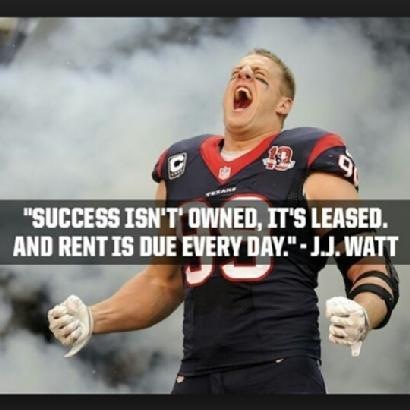
So many times we think of success as something to be attained instead of something that requires constant movement and action with the anticipated result changing as we go forward. As I get closer to turning a year older, I can help but think about how my definition of success has changed from when I was younger. There are still so many things that I want to do and avenues that I haven’t explored. To me, being successful is having the freedom to do what you want when you want without the confinement of a tradition 9-5 job. The ability to turn down opportunities because you don’t need the money and to travel all over just because you want to. That’s what I want. However it’s important to remember that success requires consistent effort towards sometime specific. You really can’t be halfway successful. You have to be willing to put in the time daily and be disciplined enough to not require constant external motivation.
Instinct
Back in May of this year I took a weekend trip to Dallas and was introduced to this book by some friends. I’ve always been wary of self help books, but this one was different. Lately I’ve been running into a lot of people who just seem stuck. They work, go home and repeat for years without really doing anything different. They always talk about places they want to travel to but they know they’ll never go. Their lives consist of the mundane without any plans to change their routine. I am deathly afraid of becoming one of those people. This book was honestly one of the top three books I read this year. It focuses specifically on becoming the best you that you can be by making use of your unique talents and gifts. Jakes uses great examples and simple language to encourage the reader to take inventory of his or her passions and then use them to make a difference in the world. The biggest challenge in doing this is that it requires you to get out of your comfort zone and leave the familiar. You’re exchanging security for freedom. But the end result to doing this is fulfillment and the opportunity to actually leave a legacy that you’re proud of.

 Alisha's Angle