The real you

The real you

These words are so true in my opinion. As soon as I saw the picture I knew that I had to write on it. First off, I’m not a very patient person. I don’t usually have a problem waiting, but I do have a problem patiently waiting. One of the hardest situations for me is being in a situation where I can’t occupy myself with something else while I’m waiting. I recently got called for jury duty and I had an extremely hard time sitting in a room with nothing to do for a few hours with a several hundred people waiting for my number to be called. But I digress. The point of the picture as it pertains to patience is that patience is extremely hard to come by when you are waiting for everything. There are numerous rags to riches stories of people who went to poverty and still were patient and believed that their circumstances would not be forever. The second part of the picture talks about attitude. I think that we’ve all known someone or even been in a position ourselves where we’ve gotten a raise, promotion or some sort of upgrade in life and our attitude changes. Your thinking won’t change just because the amount of material possessions that you own did. I think that having “everything” is a magnifying glass on your true attitude. It’s interesting how our circumstances can be so revealing of who we really are as people. They can shape our perspective and make us more trusting or more suspicious of others. They can not only change us, but also show others our true colors and motives.
Who’s your hero?

I think that everyone at some point in their childhood desired or wanted to be like someone else. Whether it was a character from a TV show, or even a person that had admirable qualities. I think that you can tell a lot about a person by who they name as their hero. I think that we pick heroes based on our own perception of our deficiencies. We pick role models based on the fact that we see something in them that we want to emulate in our own lives. I don’t remember having a lot of heroes growing up. While I admire and respected certain people for their accomplishments, I can’t honesty say that I remember declaring that so and so was my hero (or shero). I know people who have the opportunity to be mentored by other people who they consider their heroes. While I love the idea of having a mentor, role model, and hero all rolled into one person, I wonder how realistic it is to expect to encounter that. In my work with kids in the therapy room, I’ve noticed that the term “hero” can have many different meanings. I think that our heroes change as we grow older and develop our own unique perspectives. Take a minute this week to think about who your hero is and what qualities that they had (or have) that you are still working towards then jot down some ideas of what you can do or focus on to practice some of these qualities.

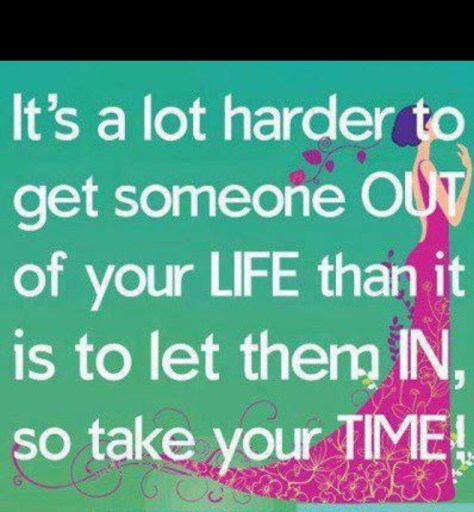
Letting People In

Letting People In

I totally agree with this picture. While I don’t think that you have to be standoffish and mean, I think that less is more when it comes to letting people get super close to you. I know that everyone is human and we all make mistakes and that we can’t expect perfection from our friends but it’s still ok to be cautious before spilling your guts to someone you call a friend but have only known a short time. Someone once said that you should never trust anyone who only has new friends because that’s an indication of the quality of their prior relationships and friendships. Sometimes doing more groundwork on the front end of a friendship or a relationship can save you a lot of heartache and hurt down the road. One thing that I’ve noticed is that I’m somewhat of an extremist when it comes to putting the words in this picture into practice. For instance, every person in my life that I consider close and feel that they know me well I’ve known for three years or more. This was not a conscious decision, it was just something that happened and can probably be blamed in some way on my upbringing. But I digress. My point is that it’s good to screen people and to let them prove that they can be trusted before you open the floodgates of your heart and let them 100% into your life.

Disposable People

Some people are disposable. And I don’t mean that in the literal way. So many times we mistake people who are our fans for friends. A fan is someone who hangs around you because they like what you’re doing. They don’t want get to know the real you and they function in the capacity of a seat filler in your life. If your life was a movie, they’d be an extra on the set. Fans like what you do but not necessarily who you are. They’ll smile in your face but if you actually ever needed them in the capacity of a genuine friend, they wouldn’t be there. Fans talk the most but rarely take the time to quietly listen. Fans are disposable. They’ll cycle in and out your life without warning. You can gain and lose fans at the drop of a hat but friends will stick with you. That’s why you don’t want to make a friend out of a fan. Fans won’t be around when you hit rock bottom because they never cared about you in the first place. They just thought it was cool to hang around you and be nosy. Bottom line. Fans are disposable, friends aren’t.

Know Your Audience

One thing that struck me today was the importance of knowing your audience. This proves true in so many situations. We can all think of a teacher or someone in a leadership position that pretty much sucked at their job because they did not know how to effectively communicate their ideas and thoughts to their audience. Personally, I hate being in these type of situations because I feel like I’m at the mercy of the speaker and that while they may have knowledge that is applicable to my life, they lack the ability to convey it to me and their audience. The same proves true with people who may not be in a leadership capacity. Even when talking to friends it’s important to think about how someone will take what you say. Some people need a straightforward approach while others respond better when the words are gently padded. It’s all about knowing the audience that you’re speaking to. No one would speak to a group of five year olds in the same way that they spoke to a group of people in their 30’s. Each group is different and the speaker’s approach should be tailored to the needs of the group. There’s no reason for a “one size fits all” approach when dealing with people. People don’t want to be talked down to. They want to listen to someone who can empathize with their current situation and communicate ideas in a way that helps them. Otherwise, they’ll just get bored and tune out.

Your better half

I think that many times we settle for the company of people who aren’t good for us because we don’t want to be alone.  Humans are social creatures and we get used to having other people around us. Singles are told that they are just half a person walking around until they find their “better half.” But what happens when you are the “better half” of a friendship or a relationship? What happens when you wake up one morning and discover that you’ve sold yourself short in the friendship/relationship? Do you decide to put some distance between you and the other person? Or do you decide to push through and continue on? Many times people don’t give up relationships or friendships because they’ve grown accustomed to the dysfunction that they bring to their lives. We all have a little crazy in us right? But the point is that at the end of the day, you don’t want to be weighed down by people who are only in your life because you’re lonely. Sometimes being alone isn’t a bad thing if it’s for a reason. The quality over quantity perspective should always apply to friendships and relationships. After all, it’s better to have a few real friends than thousands of fake ones.

Birds of a Feather

Something that’s been in the forefront of my mind for the past few days is the importance of good friends. No one is an island despite their best efforts to be one. At some point in your life, you either needed someone for something (childhood) or you’ll need someone in the future. Guaranteed. There’s a saying that basically says that you can know about someone’s character by looking at their friends.  I think that a lot of pseudo-friendships are formed out of a sense of pity for the other person. Many times we’ll go out of our way and be inconvenienced for the other person not because they’re our friend, but because we feel sorry for them. These sympathy-friendships don’t really benefit anyone at the end of the day. That’s why I think it is so crucial to be able to differentiate between friends and associates. So many people mess themselves up because they expect friend-level actions and commitment from an associate. Give someone a chance to prove themselves before they become your new “bestie.” I think that one should have a  lot of associates but a few friends. Quality always is better than quantity because good friendships rarely happen overnight. A lot of times we hold on to friendships that should have ended years before because we don’t want to hurt the other person’s feelings. However, in the end, we’re the ones that suffer.  Messed up people, mess up people.  Take some time to evaluate the people that you call friends in your life. Maybe some people need to be down-graded to associates.

The Friend Dilemma

One of the very first things that couples often say or even promise to each other after a breakup is that they’ll stay friends. They swear up and down that this little “hiccup” in their romantic relationship will not affect their friendship. I think that this “staying friends” idea is just a way for both parties to feel better about the breakup. I don’t think that it’s possible for couples to be friends right after they break up. There’s too much history. Emotions are raw. The reality that they’re not together any more hasn’t even settled in yet. There needs to be a clean break that allows both people to heal and to regroup. I think that ex-couples can be friends after they both have gotten over the break up. It’s easy to claim to be friends when on ex-partner wants to resume the relationships and uses the “just friends” story in order to make a demand on the other ex-partner’s attention and time. All this could be easily avoided if both individuals took the time to honestly evaluate their feelings and to regroup. There’s no need to be friends right after a breakup. It doesn’t serve a purpose and (in my opinion) is just plain dumb. Thoughts?